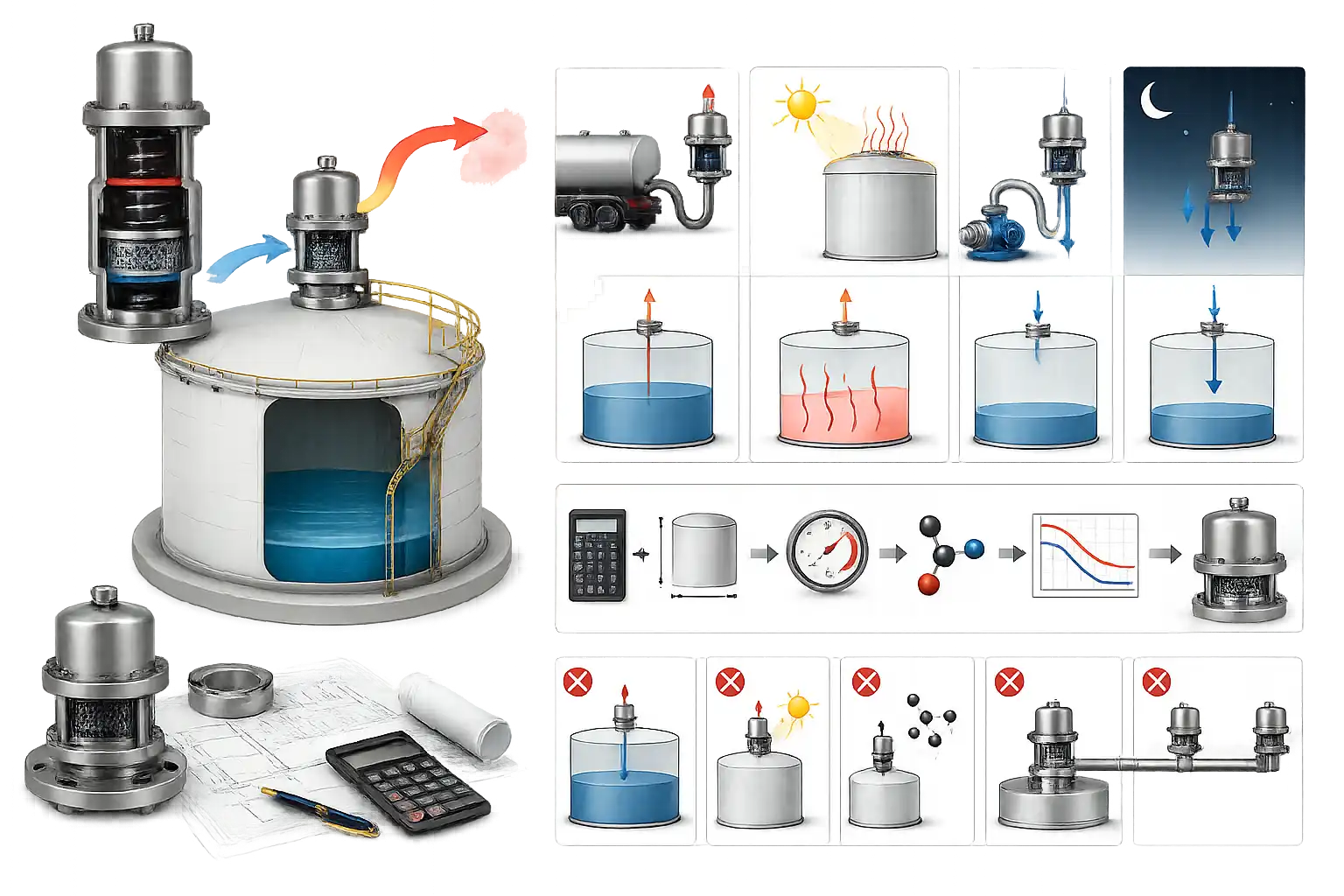
Every nitrogen blanketed storage tank breathes — constantly, silently, and invisibly. Every time you pump liquid
in, liquid out, or the sun heats your tank roof, the nitrogen headspace pressure shifts. Without a
breather valve precisely matched to your tank, nitrogen, and stored liquid, that invisible
breathing becomes a structural threat. This guide gives you everything — working principle, nitrogen blanketing
physics, API 2000 sizing, weight loaded vs spring loaded selection, material guide, step-by-step installation, and
maintenance schedule — to get it right the first time.
Whether you are a process engineer specifying a new tank, a plant manager upgrading an existing venting system,
or a procurement professional sourcing a breather valve supplier in India, this guide will
answer every question — from "what is a breather valve?" to "how do I set the correct pressure for a nitrogen
blanketed tank?"
1. What Is a Breather Valve? — Definition and All Names
📘 Definition — Breather Valve (All Names)
A breather valve — also known as a conservation vent, tank breather
valve, breather vent valve, pressure/vacuum (PV) valve,
pressure vacuum relief valve, or air breather valve — is a dual-function,
self-actuating safety device installed on the vent nozzle of atmospheric and low-pressure fixed-roof storage
tanks. It automatically opens to release excess internal pressure (outbreathing) when pressure rises above the
set point, and opens again to admit air or inert gas (inbreathing) when internal pressure drops below the set
vacuum level — protecting the tank from structural damage in both directions during normal operations.
You may encounter this device under many different names depending on industry, region, and application. Here
is a complete reference of every term used for a breather valve and what each emphasises:
Name Used
What It Emphasises
Common In
Breather Valve
The act of the tank "breathing" during operations
India, South Asia, general industry
Conservation Vent
Conserving vapour — reducing evaporation losses
Oil & Gas, Petrochemical (API terminology)
PV Valve / P&V Valve
Pressure and Vacuum — dual function
Worldwide — engineering and specification use
Pressure Vacuum Relief Valve
Relief from both overpressure and under-pressure
Chemical, Pharmaceutical, Food industries
Tank Breather Valve
Specifically for storage tank applications
General industry, procurement terminology
Breather Vent Valve
Combined vent and breather function
Water treatment, utilities, OEM spec sheets
Air Breather Valve
Admits ambient air during vacuum (non-inert blanketing)
Water tanks, non-flammable storage, HVAC
Water Tank Breather Valve
Application-specific — potable water or fire water tanks
Municipal water, fire protection systems
Atmospheric Vent Valve
Venting at near-atmospheric pressure
Low-pressure storage, utility tanks
Key Point: Regardless of what name appears on the purchase order or P&ID — breather valve,
conservation vent, PV valve, or pressure vacuum relief valve — they all refer to the same category of device.
The selection criteria, sizing standard (API 2000), and installation requirements are identical.
2. How Does a Breather Valve Work?
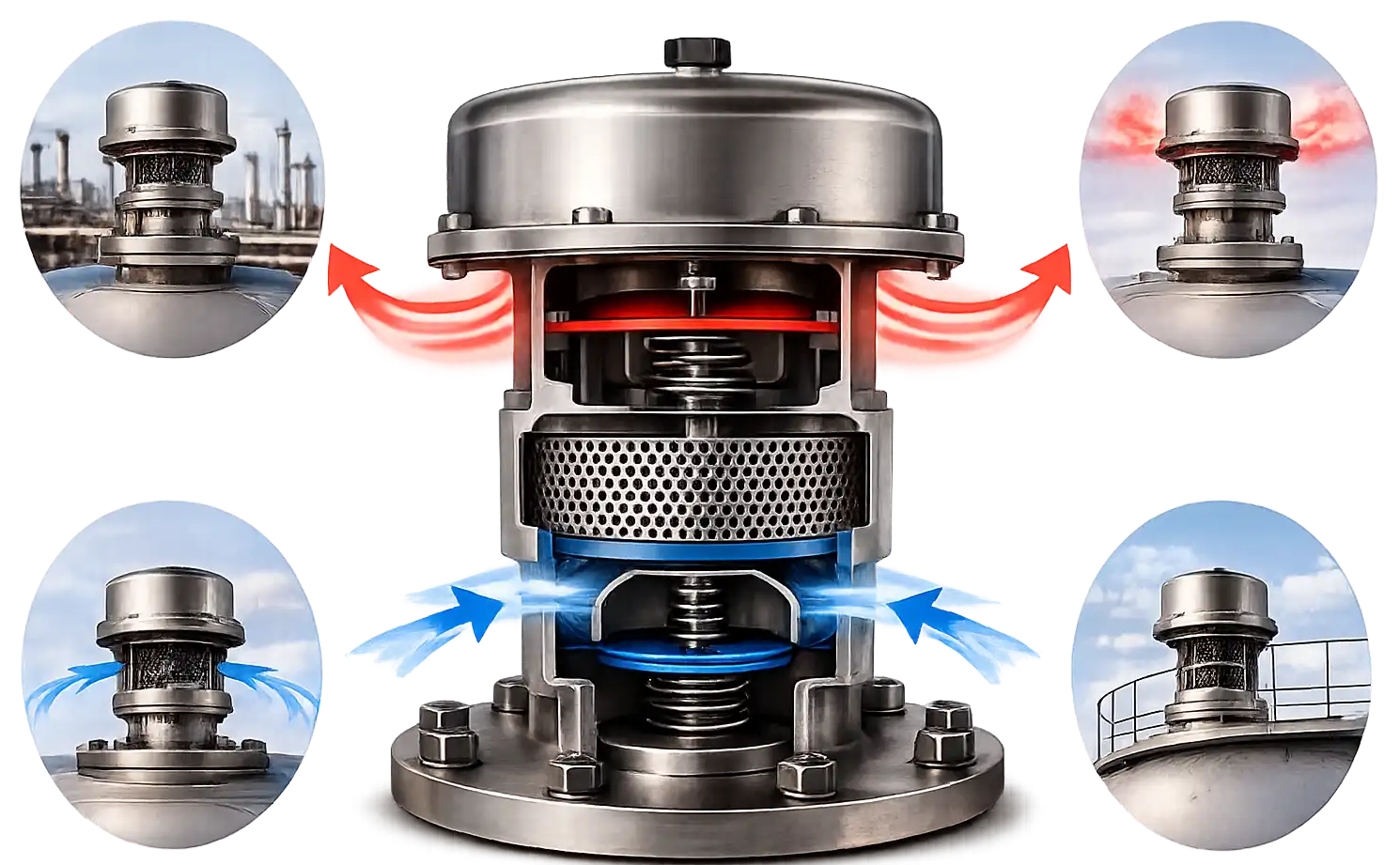
A breather valve contains two independent pallet and seat assemblies housed in a single body — one for the
pressure (outbreathing) function and one for the vacuum (inbreathing) function. In nitrogen blanketed tanks,
both pallets are in constant play throughout the day.
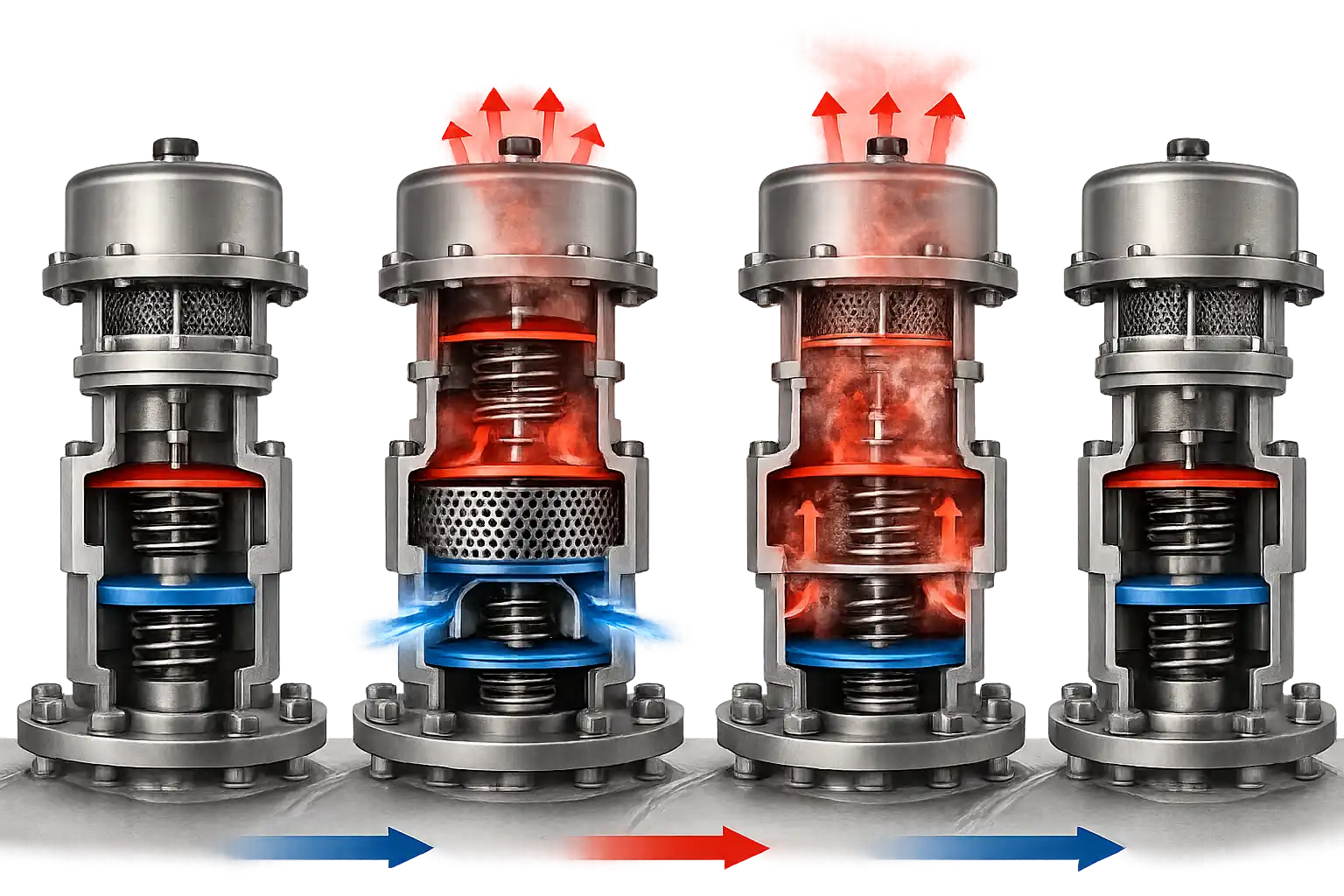
The Pressure (Outbreathing) Function
Trigger condition
Internal tank pressure rises above the set pressure — caused by filling, liquid heating, nitrogen
overfeed, or solar radiation on the tank roof raising vapour pressure.
Pallet lifts
The outbreathing (pressure) pallet — held down by its weight or a calibrated spring — lifts when the
upward force of the gas exceeds the pallet's set weight or spring force.
Vapour or gas releases
Nitrogen-vapour mixture vents to atmosphere through the flame arrestor screen, reducing internal pressure
to within safe limits.
Pallet reseats
When internal pressure drops back to normal, the pallet reseats under gravity (weight loaded) or spring
return (spring loaded), stopping the flow and resealing the tank.
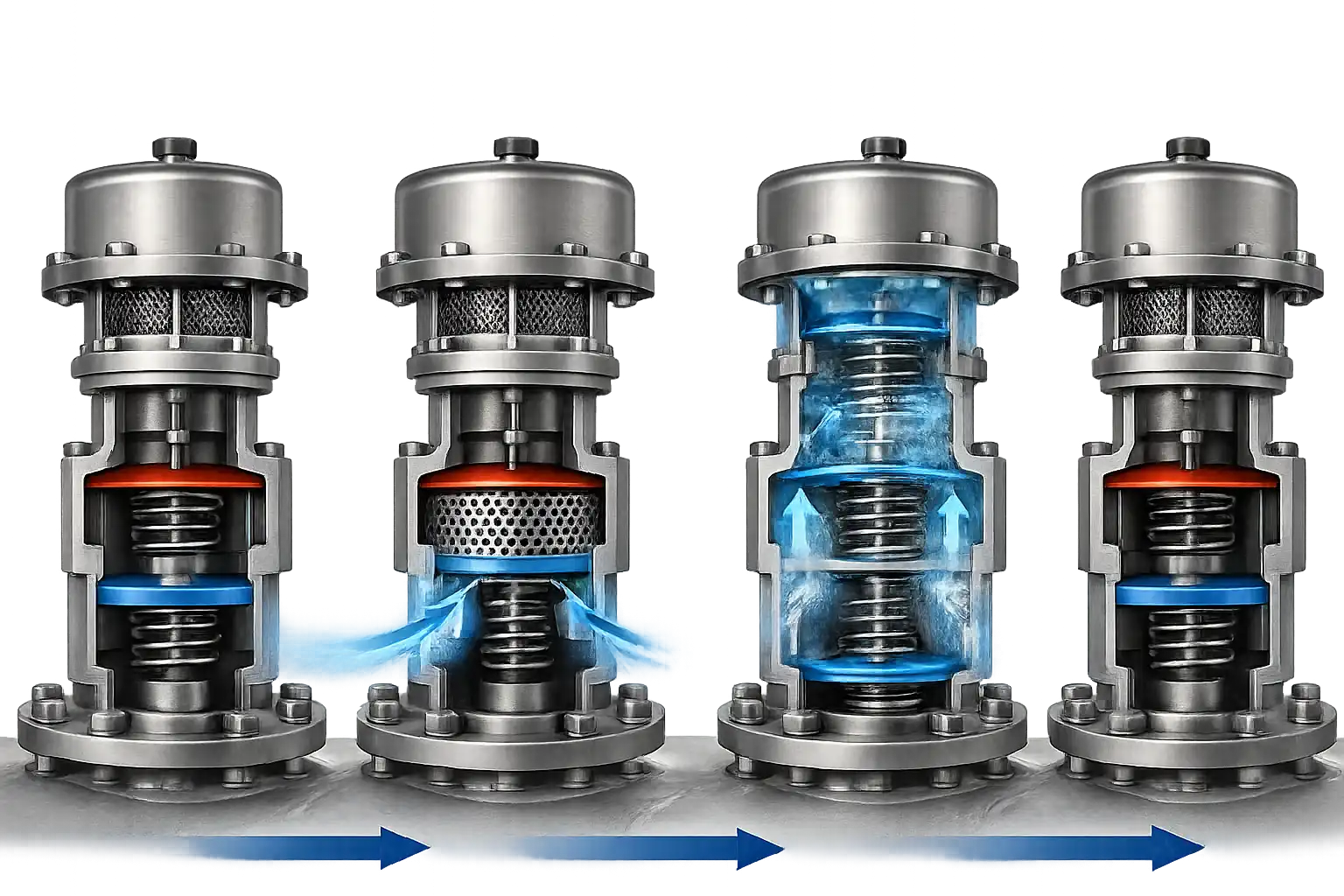
The Vacuum (Inbreathing) Function
Trigger condition
Internal pressure drops below atmospheric — caused by emptying liquid out, cooling at night, sudden
temperature drop, or nitrogen supply interruption.
Vacuum pallet lifts inward
The inbreathing (vacuum) pallet lifts inward when the external atmospheric pressure exceeds the internal
pressure by more than the set vacuum level.
Air or inert gas enters
In non-blanketed tanks: ambient air enters. In nitrogen blanketed tanks: nitrogen from the nitrogen
supply header enters to restore headspace pressure. The flame arrestor prevents any ignition source from
entering the tank.
Pallet reseats
Once internal and external pressures equalise, the inbreathing pallet reseats, maintaining the sealed
tank environment.
Critical Safety Note: A tank breather valve that is stuck closed on the vacuum side will not
allow inbreathing during emptying — the result is catastrophic vacuum collapse (tank implosion). This is why
regular maintenance and inspection of both pallets is non-negotiable.
3. What Is Nitrogen Blanketing and Why Do These Tanks Need Breather Valves?
📘 Definition — Nitrogen Blanketing
Nitrogen blanketing (also called nitrogen padding or inert gas
blanketing) is a process where the headspace of a storage tank — the space above the liquid surface
— is continuously filled with dry nitrogen gas at a controlled positive pressure. The nitrogen blanket
prevents contact between the stored liquid and atmospheric oxygen or moisture, eliminating oxidation, moisture
absorption, vapour ignition risk, and product contamination.
Why nitrogen blanketed tanks need breather valves — the physics
Many engineers assume that because the tank has a nitrogen supply, it does not need a breather valve. This is
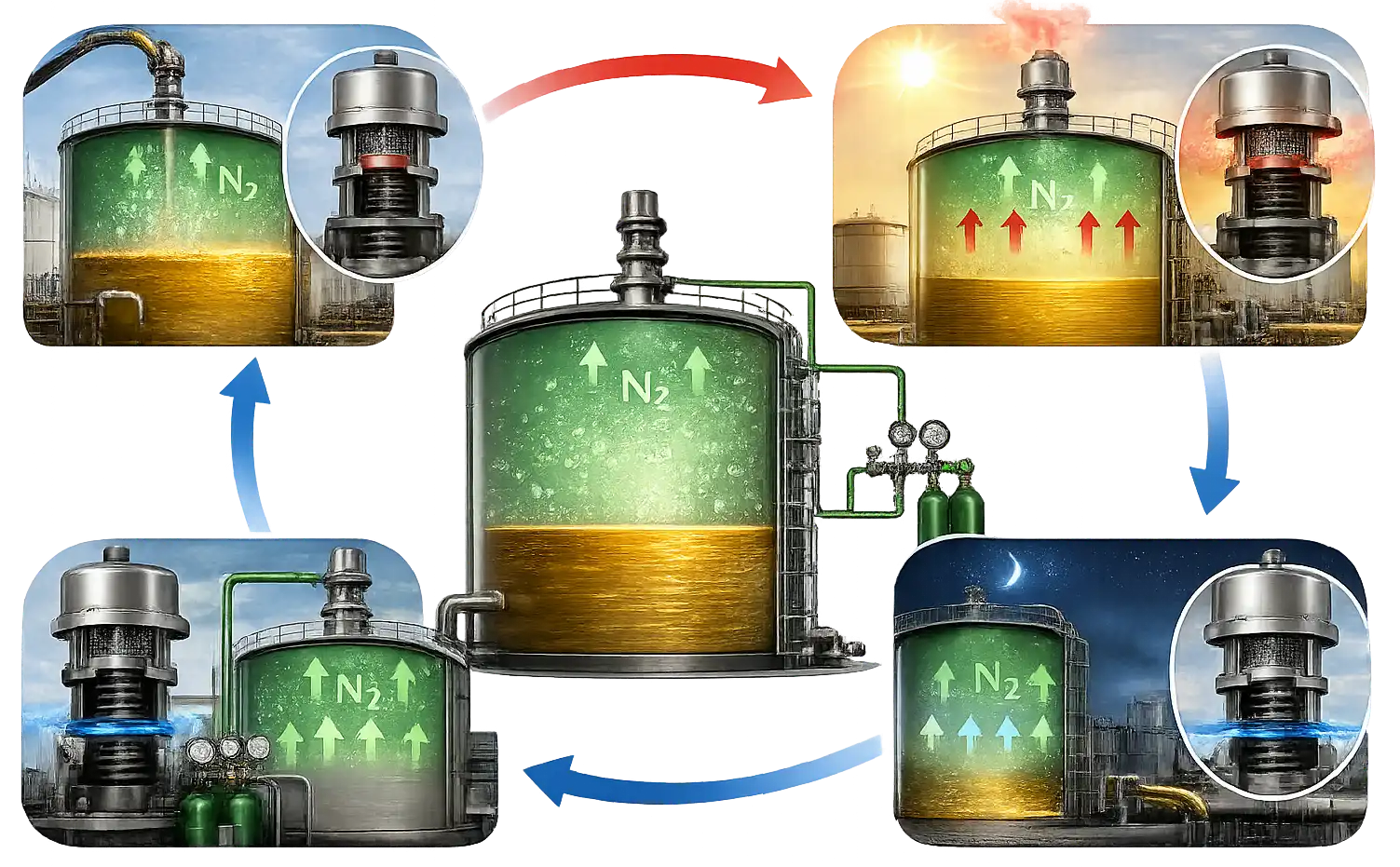
a dangerous misconception. Here is what actually happens inside a nitrogen blanketed tank throughout a 24-hour
cycle:
Day temp rise → vapour pressure increases → pressure rises
←
Breather Valve Opens (Vacuum)
N₂ from supply header enters to restore pressure
←
Emptying / Night Cooling
Liquid exits → N₂ headspace expands → vacuum forms
Product protection: The breather valve ensures the nitrogen blanket pressure stays within
its designed range — not too high (tank damage), not too low (oxygen ingress)
Nitrogen conservation: A properly set breather valve only releases nitrogen when absolutely
necessary — reducing nitrogen consumption and operating cost
VOC emission control: By opening only at the set pressure, the breather valve minimises
uncontrolled vapour losses — critical for environmental compliance and air quality regulations
Tank structural integrity: Without a breather valve, the nitrogen supply overpressure or
thermal expansion can exceed the tank's design pressure, causing bulging, weld failure, or roof plate buckling
Safety from vacuum collapse: During rapid emptying or nitrogen supply failure, the vacuum
pallet opens to prevent the devastating inward collapse of the tank shell
Nitrogen consumption tip: An incorrectly set or oversized breather valve wastes nitrogen by
opening too frequently or at too low a set pressure. Correct API 2000 sizing and accurate pressure setting
directly reduce your nitrogen operating cost.
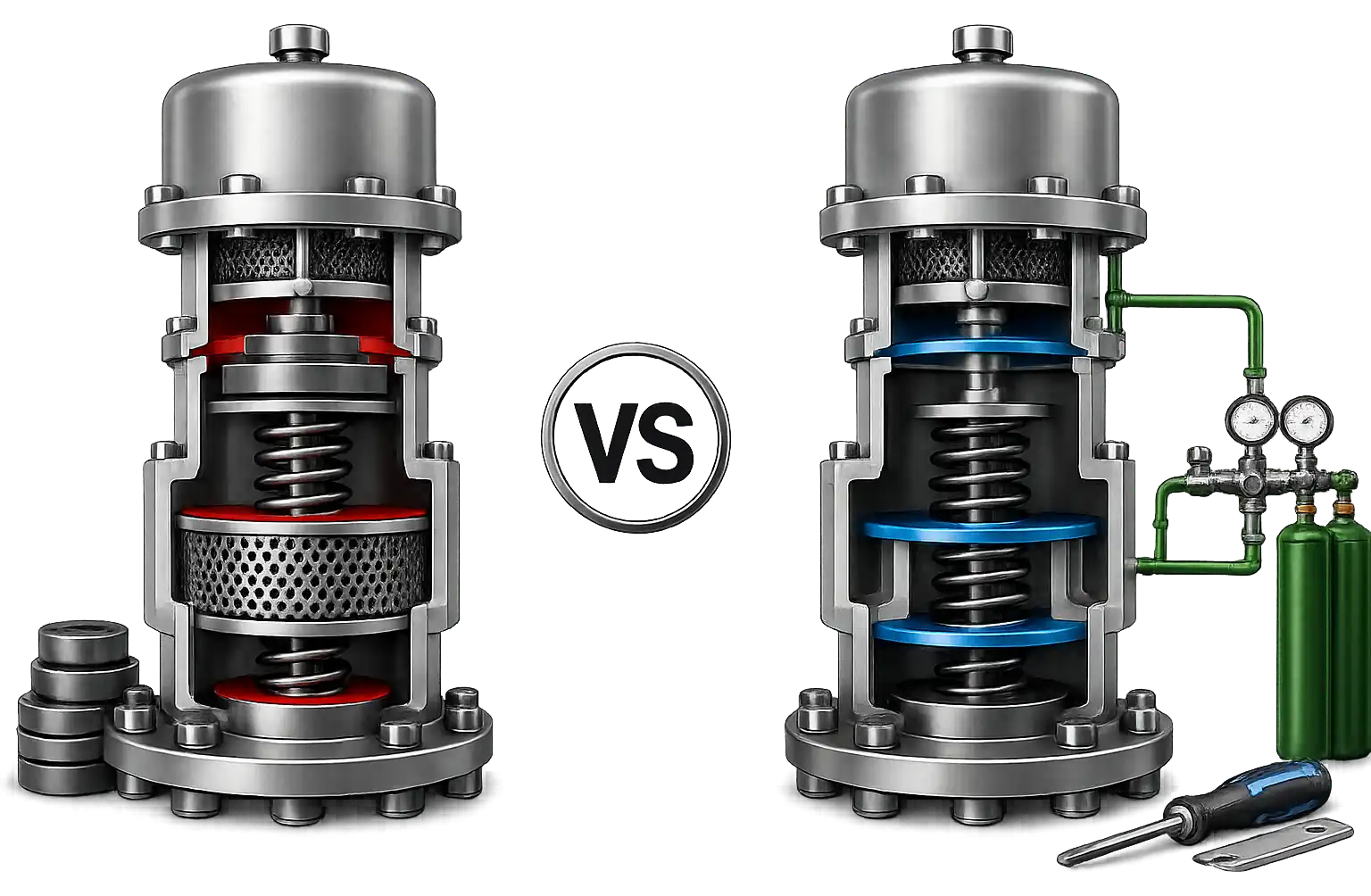
4. Types of Breather Valves: Weight Loaded vs Spring Loaded
All breather valves — whether called a conservation vent, PV valve, or pressure vacuum relief valve — come in
two fundamental actuation types. Choosing the right type is critical for reliable performance on nitrogen
blanketed tanks.
Recommendation for nitrogen blanketed tanks: For most fixed-roof, vertical atmospheric storage
tanks, a weight loaded breather valve offers the simplest, most reliable performance at very
low set pressures typical of nitrogen blanketing systems (5–50 mm WC). Use a spring loaded breather
valve when you need more precise pressure control, or when the tank or equipment may not be perfectly
vertical.
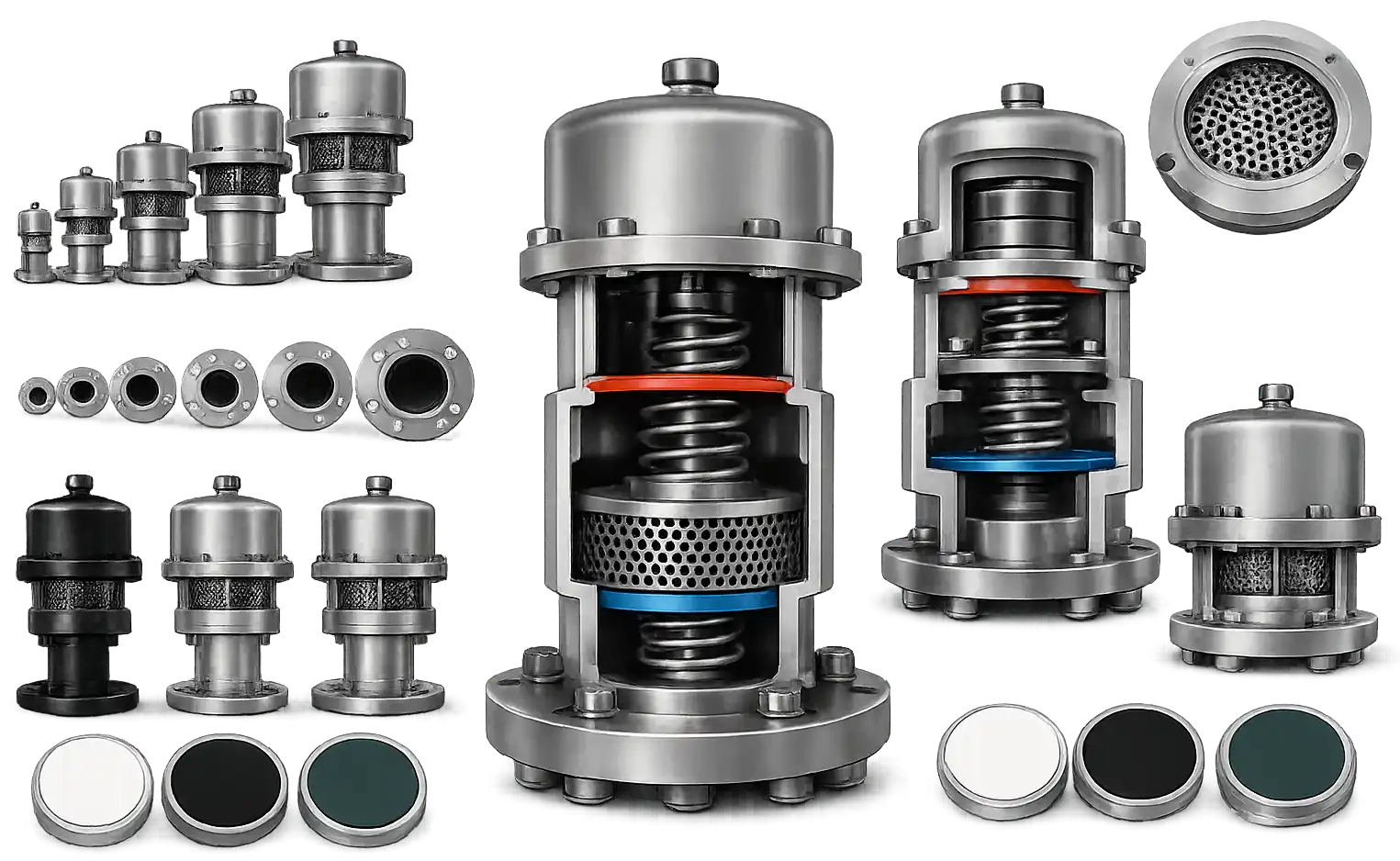
5. Ventil Breather Valve — Full Product Specifications
Ventil Components manufactures a range of breather valves from 1" to 8" in multiple materials and types, all
sized and rated to API 2000. Our unique single-piece casted design integrates the flame arrestor into the
valve body — eliminating a separate component, reducing maintenance points, and providing superior protection
for tanks storing flammable vapours.
Custom — from ±5 mm WC up to ±200 mm WC (other ranges on request)
Temperature Range
-20°C to +200°C (standard) | Cryogenic & high-temp on request
Certifications
ISO, CIMFR, MSME, Made in India
Industries Served
Oil & Gas | Chemical | Pharmaceutical | Dairy | Food & Beverage | Petrochemical | Paint &
Coatings | Nutraceuticals | Personal Care | Animal Feed
Custom Engineering
Yes — OEM and custom sizes, materials, pressure settings available
Manufactured In
Maan Hinjawadi, Pune, Maharashtra, India
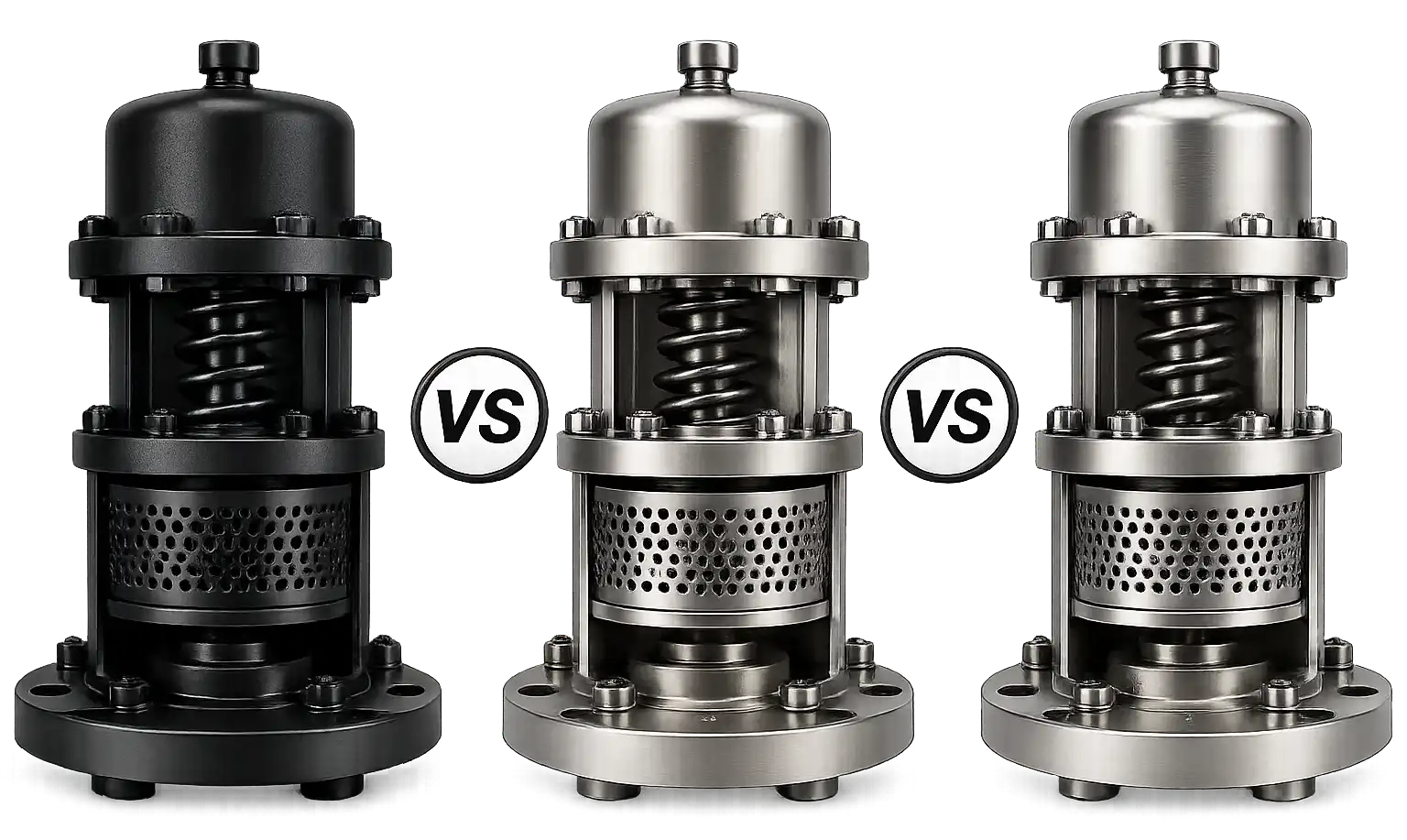
6. Material Selection Guide for Breather Valves
Choosing the right body material for your tank breather valve is critical — the wrong
material corrodes, seizes, or contaminates the stored product. Here is the complete material selection guide
for Ventil breather valves:
Carbon Steel (CS)
General petroleum storage — crude oil, diesel, furnace oil
Non-corrosive chemical storage
Water treatment storage (non-potable)
Cement & mineral slurry tanks
Cost-effective for large tank installations
Operating temp: -20°C to +200°C
Stainless Steel CF8 (SS304)
Pharmaceutical active ingredient storage
Food-grade liquid storage — edible oils, syrups
Dairy — milk, whey, cream tanks
Potable water and water tank breather valve applications
Nutraceuticals and personal care liquids
Mild acids & alkalis (non-chloride)
Stainless Steel CF8M (SS316)
Chloride-containing media — seawater, brine
Strong acids — HCl, H₂SO₄, acetic acid
Pharmaceutical — sterile API and injectables
Aggressive chemical & petrochemical service
Coastal or marine environment installations
Higher pitting and crevice corrosion resistance
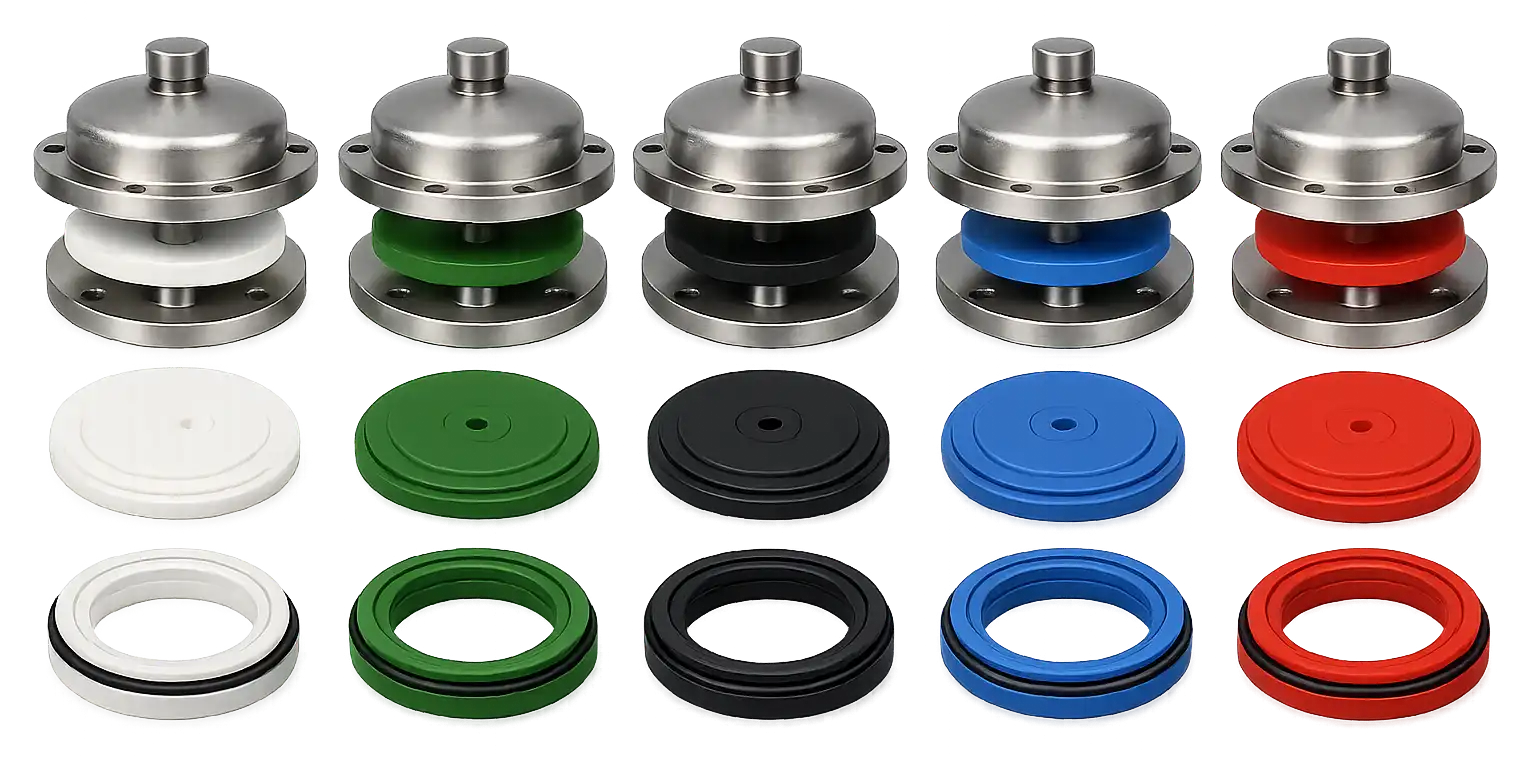
Pallet and Seat Material Selection
Seat / Pallet Material
Best For
Avoid For
PTFE (Teflon)
Universal chemical resistance, pharmaceutical, food grade, corrosive vapours
Very high temperature (>200°C) applications
Viton (FKM)
Petroleum, solvents, aromatic hydrocarbons, high temperature up to 200°C
Ketones (MEK, acetone), esters, amines
EPDM
Steam, hot water, alkalis, ozone-resistant outdoor service
Petroleum, oils, aromatic hydrocarbons
Buna-N (NBR)
Petroleum products, aliphatic hydrocarbons, fats and oils
Aromatic solvents, ketones, ozone
Silicone
High purity, food-grade, wide temperature range (-60°C to +230°C)
Aromatic hydrocarbons, concentrated acids
7. Breather Valve Sizing — API 2000 Guide
All breather valves on atmospheric and low-pressure storage tanks must be sized in accordance with
API 2000 (Venting Atmospheric and Low-Pressure Storage Tanks). Undersizing causes
overpressure or vacuum failure; oversizing causes excessive nitrogen loss and vapour emissions. Correct sizing
is both a safety and a cost requirement.
What API 2000 requires you to calculate
API 2000 Breather Valve Sizing Parameters
Outbreathing (Pressure) — FillingBased on maximum liquid filling rate into the tankQ_out = Fill rate (m³/h) × 1.0 (air equivalent)
Outbreathing — ThermalBased
on tank shell area exposed to solar radiation and ambient temperature riseQ_thermal = f(Tank diameter, latitude, vapour pressure)
Inbreathing (Vacuum) — EmptyingBased on maximum liquid emptying rate from the tankQ_in = Empty rate (m³/h) × 1.0 (air equivalent)
Inbreathing — ThermalBased on
thermal contraction at night / temperature dropQ_thermal_in = f(Tank
diameter, temp drop)
Vapour CorrectionAdjust for
stored liquid vapour molecular weight vs airCorrection factor = (M_air /
M_vapour)^0.5
Final Required CapacityMaximum of: filling+thermal outbreathing or emptying+thermal inbreathingSelect valve Cv or Kv ≥ required flow at set pressure
Use Ventil's free VentilCalc Sizing Tool: Our online tool at vcplin.com/VentilCalc performs complete API 2000 breather valve sizing
calculations for your tank — no software installation, no registration required. Enter your tank dimensions,
filling/emptying rates, and stored liquid properties to get the correct breather valve size recommendation.
Common sizing mistakes to avoid
Sizing only for filling rate without adding the thermal outbreathing component — results in undersized valve
Ignoring vapour molecular weight correction for dense vapours — leads to significant sizing error
Using the same size as the vent nozzle without calculating required flow capacity
Not accounting for back pressure from downstream flame arrestor or piping
Using a single valve where API 2000 requires separate inbreathing and outbreathing devices
8. Setting the Correct Breather Valve Pressure for Nitrogen Blanketed Tanks
The pressure setting of your breather valve on a nitrogen blanketed tank is one of the most critical
parameters to get right. It directly affects nitrogen consumption, product integrity, tank safety, and
regulatory compliance.
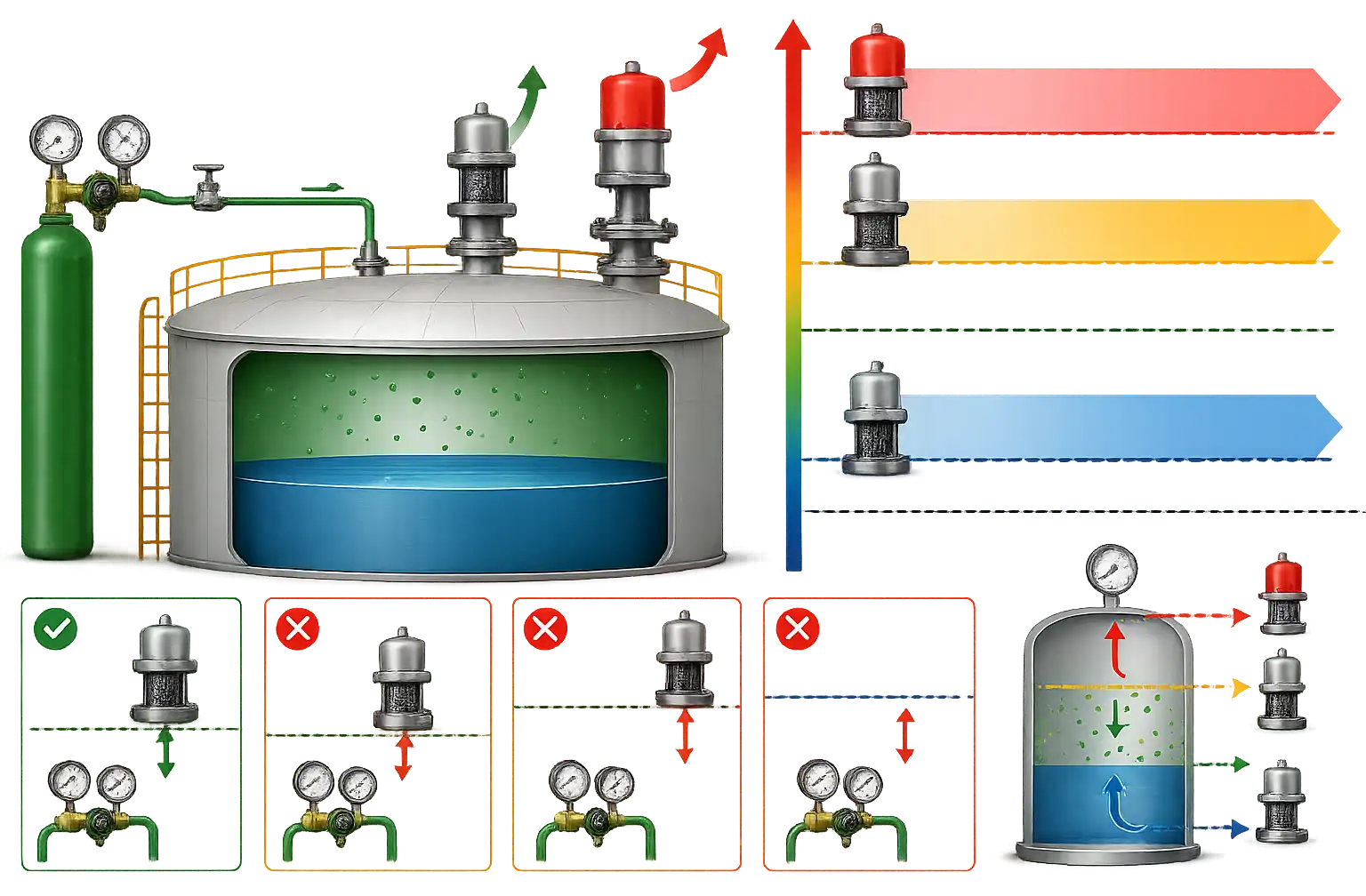
The pressure hierarchy for nitrogen blanketed tanks
Device / Condition
Pressure Level
Function
Nitrogen blanket operating pressure
Baseline (e.g., +20 mm WC)
Maintains inert atmosphere above liquid
Breather valve — pressure set point
Above N₂ blanket pressure (e.g., +35–50 mm WC)
Releases excess N₂ + vapour when pressure rises too high
Breather valve — vacuum set point
Below N₂ blanket pressure (e.g., -5 to -15 mm WC)
Allows N₂ from supply to enter when pressure drops
Emergency vent — pressure set point
Above breather valve pressure set point
Large-volume emergency relief (fire case, surge)
Tank design pressure (MAWP)
Maximum structural limit
Must never be reached during normal or emergency operation
The breather valve pressure set point must always be above the nitrogen blanket operating
pressure — so the valve does not continuously vent during normal operation
The breather valve pressure set point must be below the tank's maximum allowable working pressure
(MAWP) — so the tank is always protected
The breather valve vacuum set point must be below the minimum nitrogen blanket pressure —
so the valve opens and admits N₂ before a dangerous vacuum develops
Leave adequate margin between the nitrogen supply regulator set point and the breather valve pressure set
point — to allow normal N₂ pressure fluctuations without constant venting
Warning: If the breather valve pressure set point is too close to the nitrogen supply operating
pressure, the valve will vent continuously, wasting nitrogen and causing excessive vapour emissions. A minimum
margin of 10–15 mm WC between N₂ supply pressure and breather valve set pressure is recommended.
9. Why Your Breather Valve Needs an Integrated Flame Arrestor
For any tank storing flammable liquids or operating in a classified hazardous area (ATEX Zone 1 or Zone 2), a
breather valve with an integrated flame arrestor is not optional — it is a mandatory safety
requirement under international explosion protection standards.
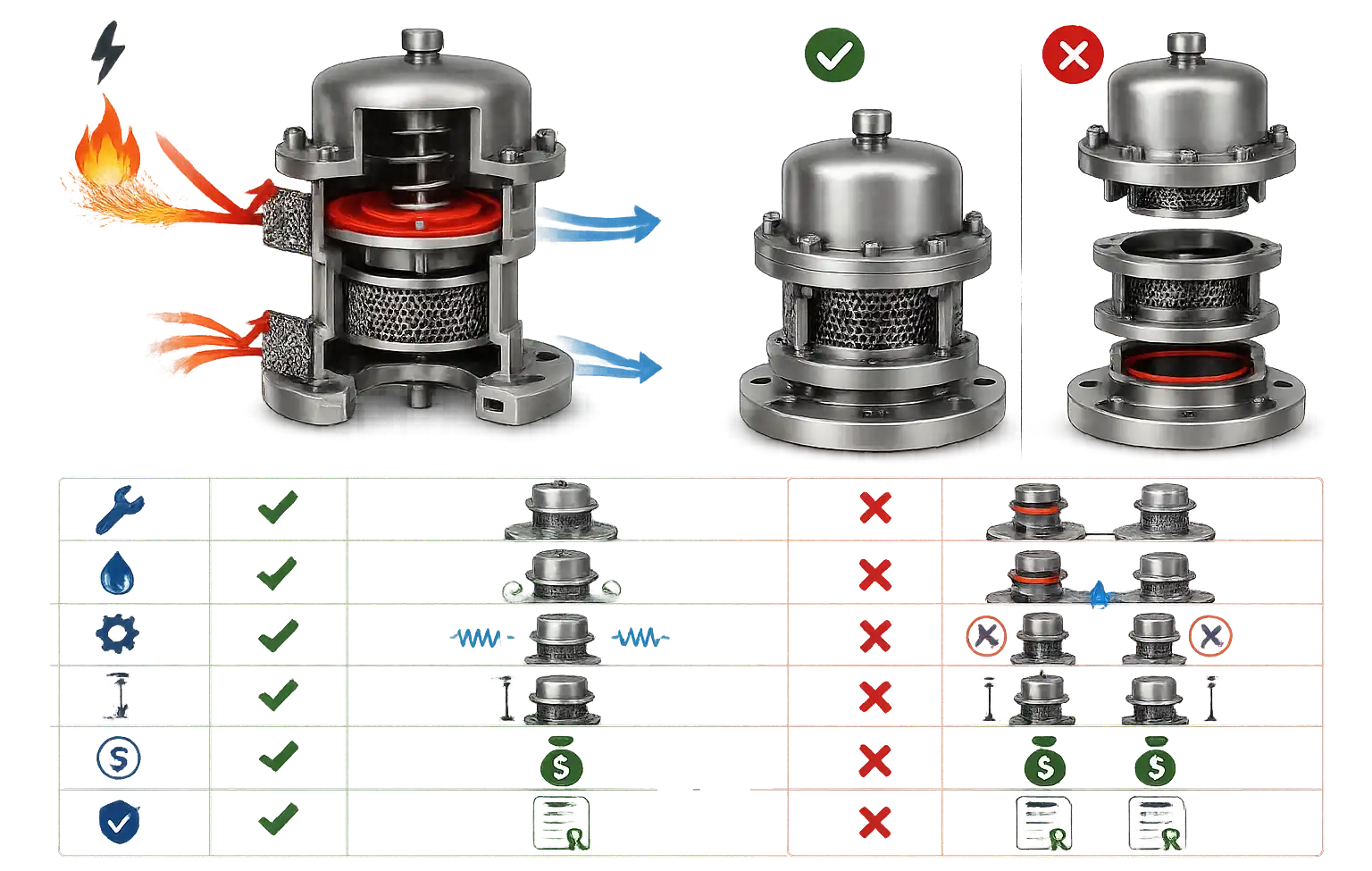
What a flame arrestor in a breather valve does
Prevents external ignition sources — sparks, open flames, lightning strikes — from propagating back through
the vent opening into the tank vapour space
Stops internal deflagration from propagating outward through the vent and igniting ambient vapour clouds
Does not restrict normal vapour venting — the mesh element has negligible pressure drop at normal breathing
flow rates
Self-cooling — the metal mesh absorbs heat from any flame front, quenching it before it can propagate
Ventil's unique integrated design advantage
Feature
Ventil Integrated Design
Separate Breather Valve + Flame Arrestor
Installation
Single flange connection — one device
Two devices, two flange connections, adapter required
Leak points
Zero additional joints between valve and arrestor
Flange joint between devices — potential leak point
Maintenance
Single disassembly — both functions accessed together
Two separate maintenance events required
Pallet chattering
Reduced — arrestor element adds damping effect
Higher — no damping between components
Space on tank nozzle
Compact — single assembly height
Taller — stacked assembly
Total cost
Lower — single item procurement and installation
Higher — two items, two sets of gaskets, longer installation time
Compliance
Single EN 12874 / API 2000 certified assembly
Two separate certifications required
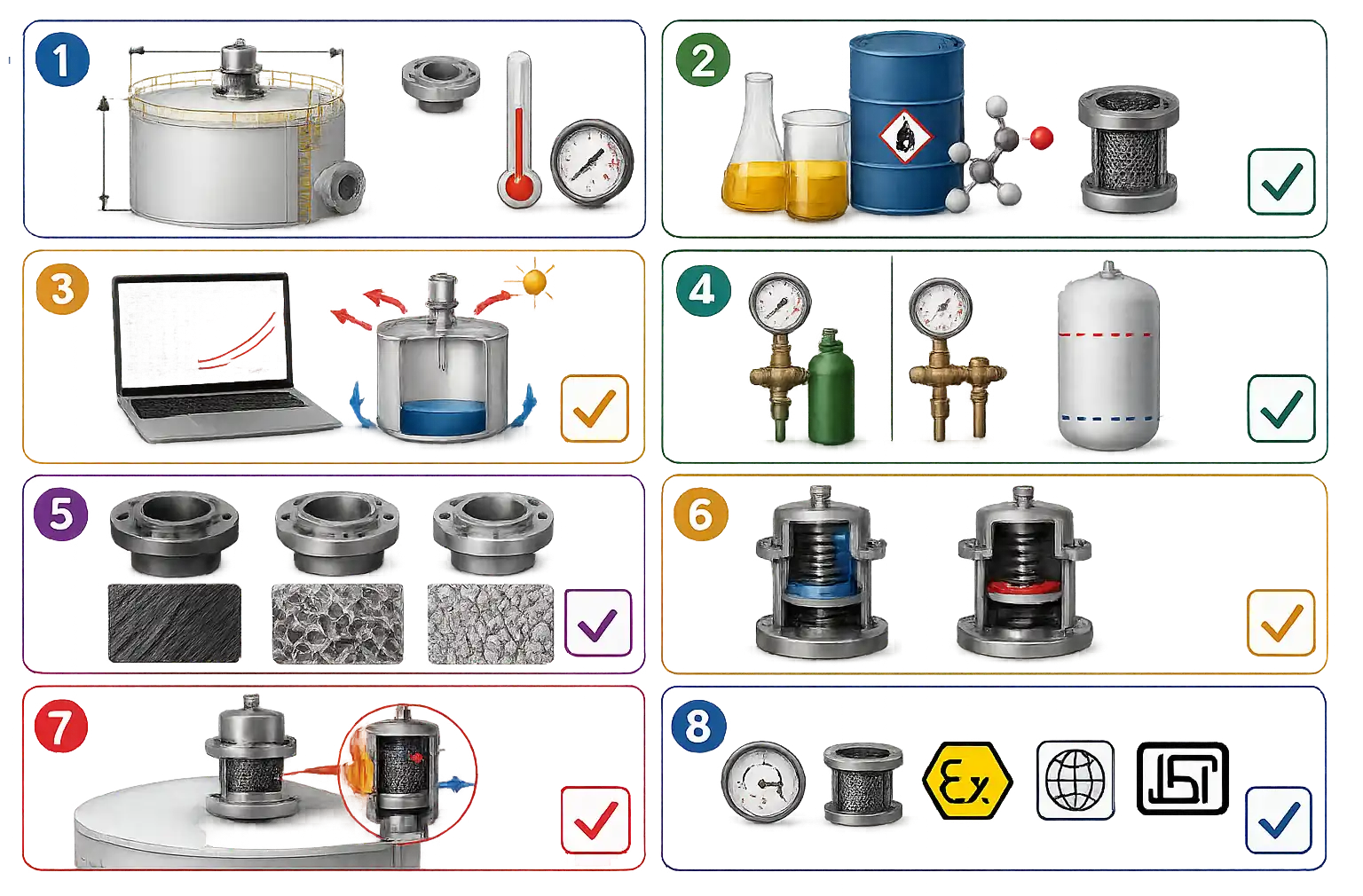
10. Breather Valve Selection Checklist
Use this checklist when specifying a breather valve for a nitrogen blanketed or any other storage tank:
Define the tank parameters
Tank diameter, height, volume, operating pressure range (MAWP), design temperature, nozzle size and
flange rating (ANSI / ASME B16.5).
Identify the stored liquid
Liquid name, molecular weight, vapour pressure at operating temperature, flammability (flash point),
viscosity, and corrosivity. This determines material of construction and whether a flame arrestor is
mandatory.
Calculate inbreathing and outbreathing rates
Per API 2000 — maximum filling rate, maximum emptying rate, thermal breathing (based on tank diameter and
location). Use the VentilCalc tool or request sizing support from Ventil.
Set the correct pressure and vacuum set points
Based on nitrogen blanket operating pressure and tank MAWP. Ensure adequate margin above N₂ supply
pressure and below MAWP.
Select body material and seat material
Based on stored liquid corrosivity, operating temperature, and regulatory requirements (food grade,
pharma, ATEX).
Specify actuation type
Weight loaded (standard fixed tanks, very low pressures) or spring loaded (precise control, non-vertical
tanks, pharma/food grade).
Confirm flame arrestor requirement
If stored liquid flash point is below 60°C or tank is in an ATEX classified area — flame arrestor is
mandatory. Specify integrated design.
Check applicable standards
API 2000 for sizing, EN 12874 for flame arrestor, ATEX / IECEx for hazardous area certification, IS 9349
for Indian regulatory compliance.
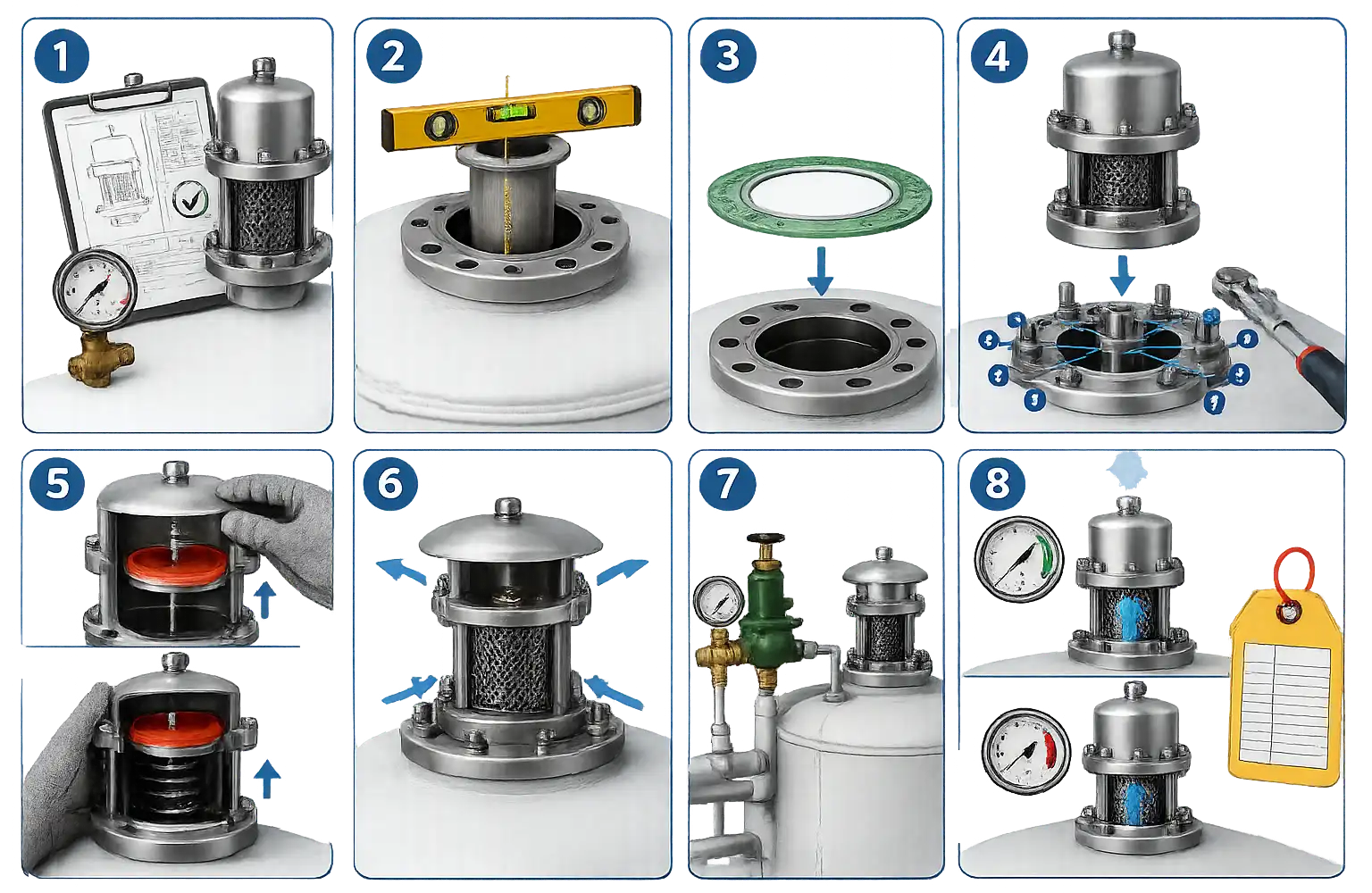
11. Breather Valve Installation Guide — Step by Step
Correct installation of a tank breather valve is as important as correct selection. Improper installation
causes premature failure, incorrect set pressure, and unsafe operating conditions. Follow these steps every
time.
1
Verify the breather valve specification before installation
Confirm size, flange rating, body material, set pressure (pressure and vacuum), and part number match the
purchase order and P&ID. Check the test certificate and API 2000 sizing sheet supplied by the
manufacturer.
⚠ Never install a breather valve without confirming the set pressure is correct for the
specific tank and nitrogen blanket operating pressure.
2
Inspect the vent nozzle and flange face
Check the tank vent nozzle flange face is clean, flat, undamaged, and free from rust, paint, or debris.
Verify the nozzle is vertical — weight loaded breather valves must be installed in a vertical position
(±2° maximum). Check the nozzle size matches the breather valve inlet size.
3
Install the correct gasket
Use the gasket material specified for the stored liquid and temperature range — PTFE spiral wound gasket
for most chemical and petroleum applications. Never reuse an old gasket. Ensure the gasket is centred on
the flange face and does not obstruct the bore.
4
Mount the breather valve — vertically
Lower the breather valve onto the nozzle flange. Hand-tighten all flange bolts evenly in a cross pattern
first. Then torque to the specified value in 3 stages using a torque wrench, following the
cross-tightening sequence. Over-tightening crushes the gasket; under-tightening causes leaks.
⚠ Weight loaded breather valves must be installed perfectly vertical. Even 5° tilt changes
the effective pallet weight and alters the set pressure.
5
Check pallet free movement after installation
After bolting, manually verify both the pressure pallet and vacuum pallet move freely — lift each pallet
gently by hand to confirm no binding, sticking, or interference. If a pallet is stuck, disassemble,
inspect, and clean before re-installation.
6
Verify the weather hood / rain cover orientation
Ensure the weather hood (rain cap / sunshade) is correctly oriented so rain, insects, and dust cannot
enter the vent opening. The vent discharge must point away from any ignition sources and be positioned to
safely disperse vapour in accordance with plant layout and safety regulations.
7
Confirm nitrogen blanket connection and pressure
For nitrogen blanketed tanks: connect the nitrogen supply regulator to the tank vent nozzle per the P&ID.
Set the nitrogen supply pressure to the required operating level. Verify the breather valve pressure set
point is correctly above the nitrogen operating pressure (see Section 8).
8
Commission and record
Slowly pressurise the tank to above the breather valve pressure set point and verify the pressure pallet
opens at the correct pressure. Depressurise below the vacuum set point and verify the vacuum pallet opens.
Record the actual opening pressures. Tag the valve with the set pressure, installation date, next
inspection date, and installer details.
12. Breather Valve Maintenance and Inspection Schedule
A breather valve that fails to open is as dangerous as having no breather valve at all. Preventive
maintenance protects your tank, your product, and your people.
Frequency
Inspection / Maintenance Activity
What to Check / Do
Monthly (visual)
External visual inspection
Check for corrosion, physical damage, bird nests or insect blockage in vent opening, missing bolts,
gasket extrusion, coating condition
Every 3 months
Pallet movement check
Manually lift both pressure and vacuum pallets to confirm free movement. Check for sticky, seized, or
stuck pallets — especially in corrosive or waxy media service
Every 6 months
Flame arrestor element inspection
Remove and inspect flame arrestor mesh/element for corrosion, clogging with wax, polymerised vapour,
or particulates. Clean with solvent or replace if damaged
Every 12 months
Full maintenance service
Disassemble completely. Inspect and replace pallet seats and seals (PTFE, Viton, EPDM). Verify pallet
flatness. Clean all internal surfaces. Re-test set pressure and vacuum setting. Reinstall with new
gaskets
After any fire event
Mandatory replacement
Replace the flame arrestor element and inspect pallet seats after any confirmed flame arrestor
activation — the element may have absorbed heat and lost integrity
After process upset
Inspection and functional test
After any overpressure, vacuum collapse, or process upset — inspect both pallets and seats, verify set
pressures, replace if any damage found
Pro maintenance tip: In services where vapour condenses or polymerises on the pallet and seat
(e.g., resins, adhesives, bitumen storage), increase inspection frequency to every 4–6 weeks. Sticky pallet
seats are the most common cause of breather valve failure in these applications.
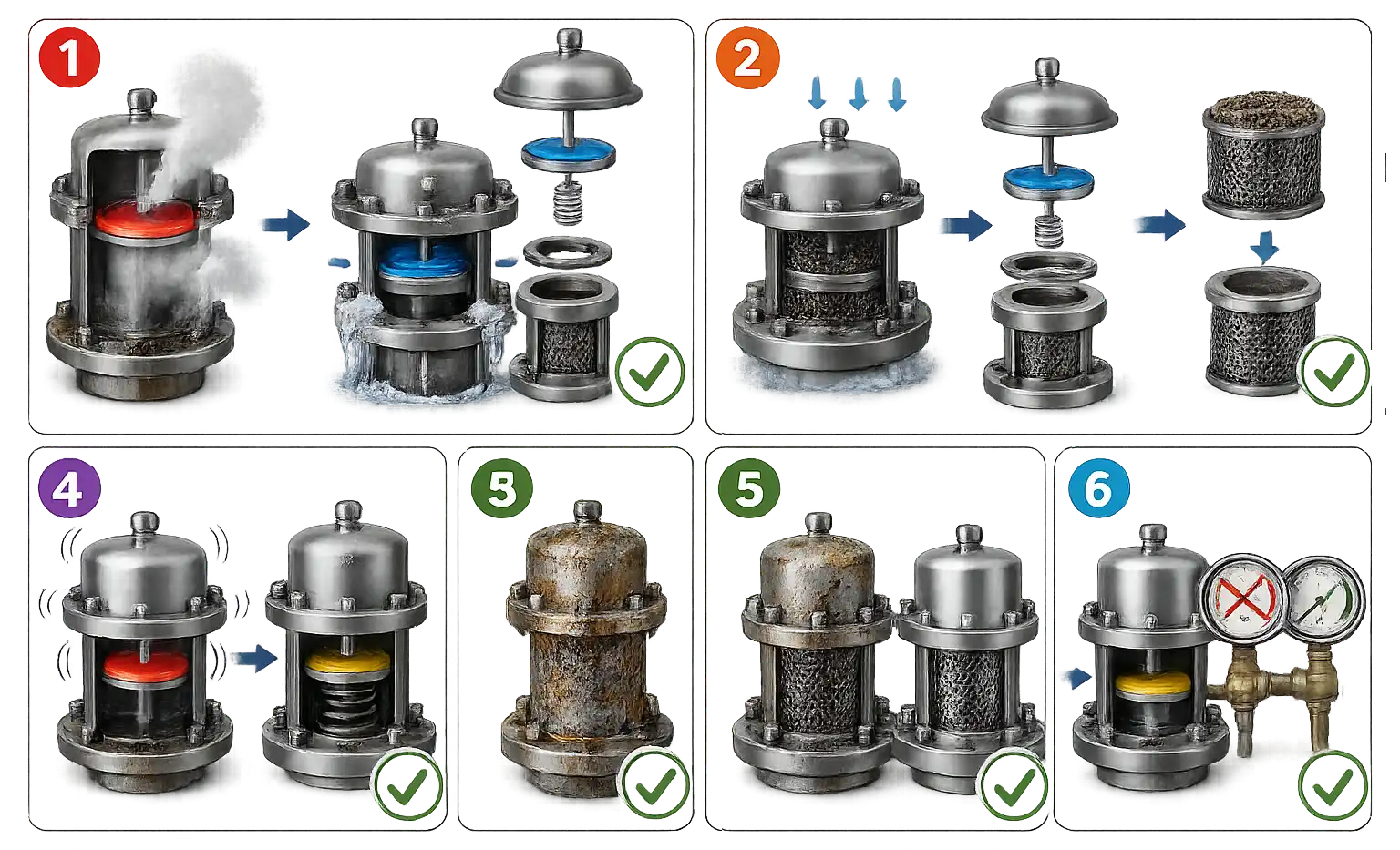
13. 6 Common Breather Valve Failures and How to Fix Them
1
Stuck-open pressure pallet — continuous venting
Pallet fails to reseat after venting. Cause: pallet corrosion, seat contamination with wax or polymerised
vapour, bent pallet stem, or pallet weight off-centre. Tank loses nitrogen and product vapour
continuously.
✔ Fix: Disassemble, clean or replace pallet and seat, check pallet stem alignment, inspect
gasket sealing surface.
2
Stuck-closed vacuum pallet — tank vacuum collapse risk
Vacuum pallet fails to open during emptying or nitrogen loss. Cause: corrosion seizing the pallet, ice
formation in cold climates, polymerised vapour bonding the seat, or foreign matter blocking pallet travel.
Most dangerous failure mode — can cause catastrophic tank implosion.
✔ Fix: Immediate inspection and disassembly. Clean, free, or replace vacuum pallet assembly.
Check for ice — install heat tracing if in cold climate.
3
Blocked flame arrestor element — elevated back pressure
Flame arrestor mesh blocked by dust, wax, polymerised hydrocarbon, insects, or corrosion. Causes elevated
back pressure — breather valve opens at higher than set pressure or does not open at all. Dangerous loss
of tank protection.
✔ Fix: Remove and clean arrestor element with appropriate solvent. Replace if mesh is
damaged, corroded, or deformed.
4
Pallet chattering — rapid, repetitive opening and closing
Pallet opens and reseats repeatedly in rapid succession, causing vibration, pallet wear, and seat damage.
Cause: operating pressure too close to the breather valve set pressure, especially in nitrogen blanketed
tanks where the N₂ supply pressure is set too high.
✔ Fix: Increase the margin between nitrogen operating pressure and breather valve set
pressure. Adjust nitrogen regulator. Consider switching from weight loaded to spring loaded type for
better seating force.
5
External corrosion — body and bonnet degradation
Breather valve body or bonnet corrodes due to environmental exposure, coastal salt air, acid rain, or
chemical vapour contact. Reduces structural integrity and can cause pallet misalignment.
✔ Fix: Upgrade to SS304 or SS316 body material for corrosive environments. Apply protective
coating. Increase inspection frequency in marine or acidic environments.
6
Set pressure drift — incorrect actual set pressure
In weight loaded types: pallet weight dislodged or corroded. In spring loaded types: spring fatigue over
time. Actual opening pressure drifts from original set value — either venting too early (nitrogen waste)
or too late (overpressure risk).
✔ Fix: Annual pressure test and verification. Replace worn springs. Re-weigh and verify
pallet weights in weight loaded types. Document actual test results vs set pressure.
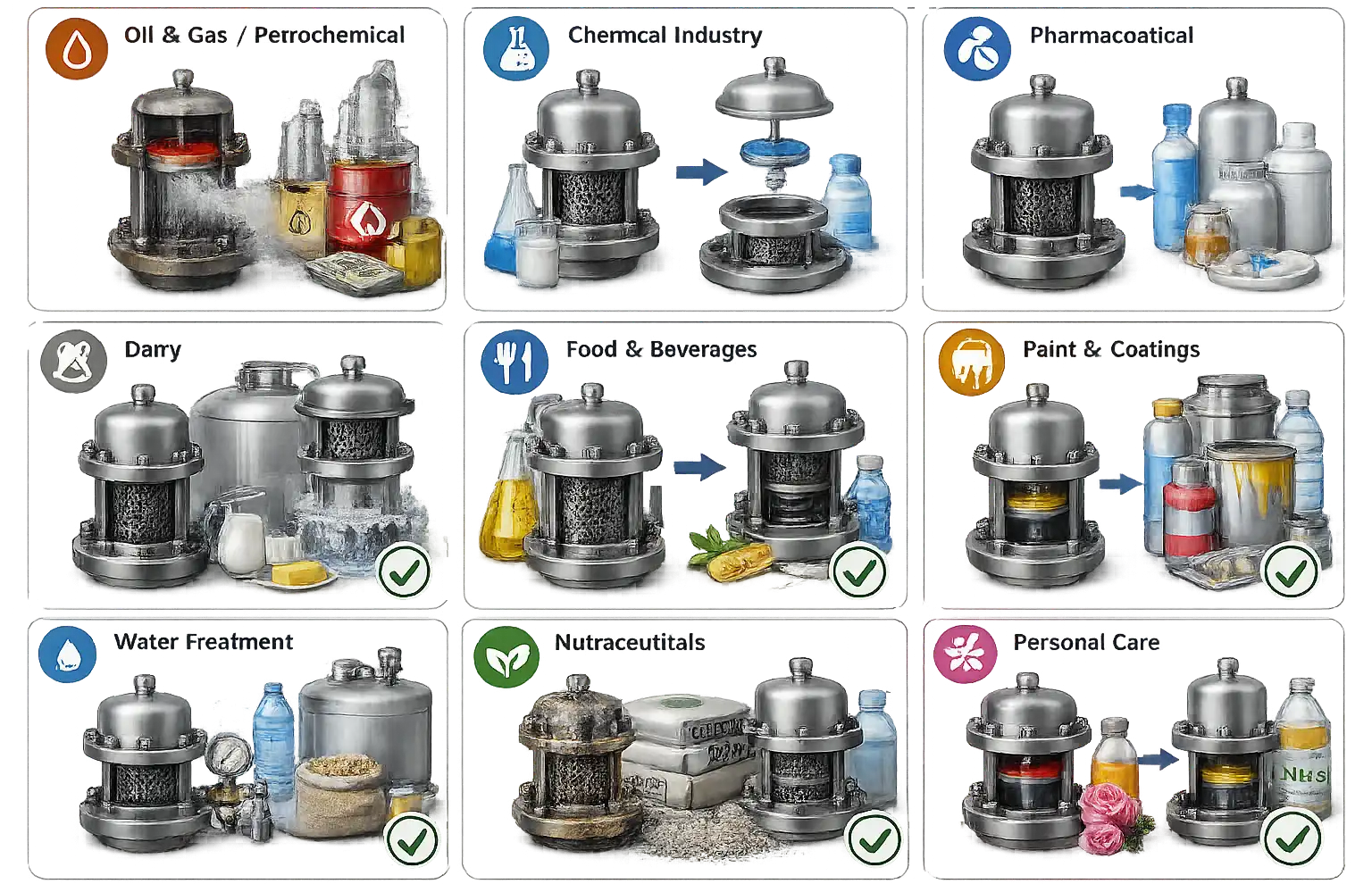
14. Breather Valves Across Industries — Application Guide
Ventil supplies breather valves, conservation vents, and PV valves across a wide range of industries. Each
industry has specific requirements for material, set pressure, and special features.
🛢️
Oil & Gas / Petrochemical
Crude oil, naphtha, condensate, fuel oil storage tanks. API 2000 required. Flame arrestor
mandatory. CS or SS316 body.
⚗️
Chemical Industry
Solvent, acid, alkali, resin storage tanks. Material selection critical — SS316 with PTFE
seats for aggressive media. Flame arrestor for flammables.
💊
Pharmaceutical
API storage, solvent tanks, WFI tanks. SS316 body, PTFE seats, GMP-compatible design.
Nitrogen blanketing standard. Spring loaded preferred.
🥛
Dairy
Milk, cream, whey, butter oil storage. SS304 body, EPDM or Silicone seats,
CIP-compatible. Air breather valve or nitrogen blanketed types.
Fat and oil storage for animal nutrition. CS or SS304, EPDM or NBR seats. Tank breather
valve for closed storage.
🏗️
Cement & Mining
Chemical reagent storage, process water tanks. CS body, robust construction,
dust-resistant vent screen. Air breather valve type.
🧪
Fertilizers
Ammonia, urea solution, acid tanks. SS316 body, PTFE seats for corrosive media. Nitrogen
blanketing for sensitive formulations.
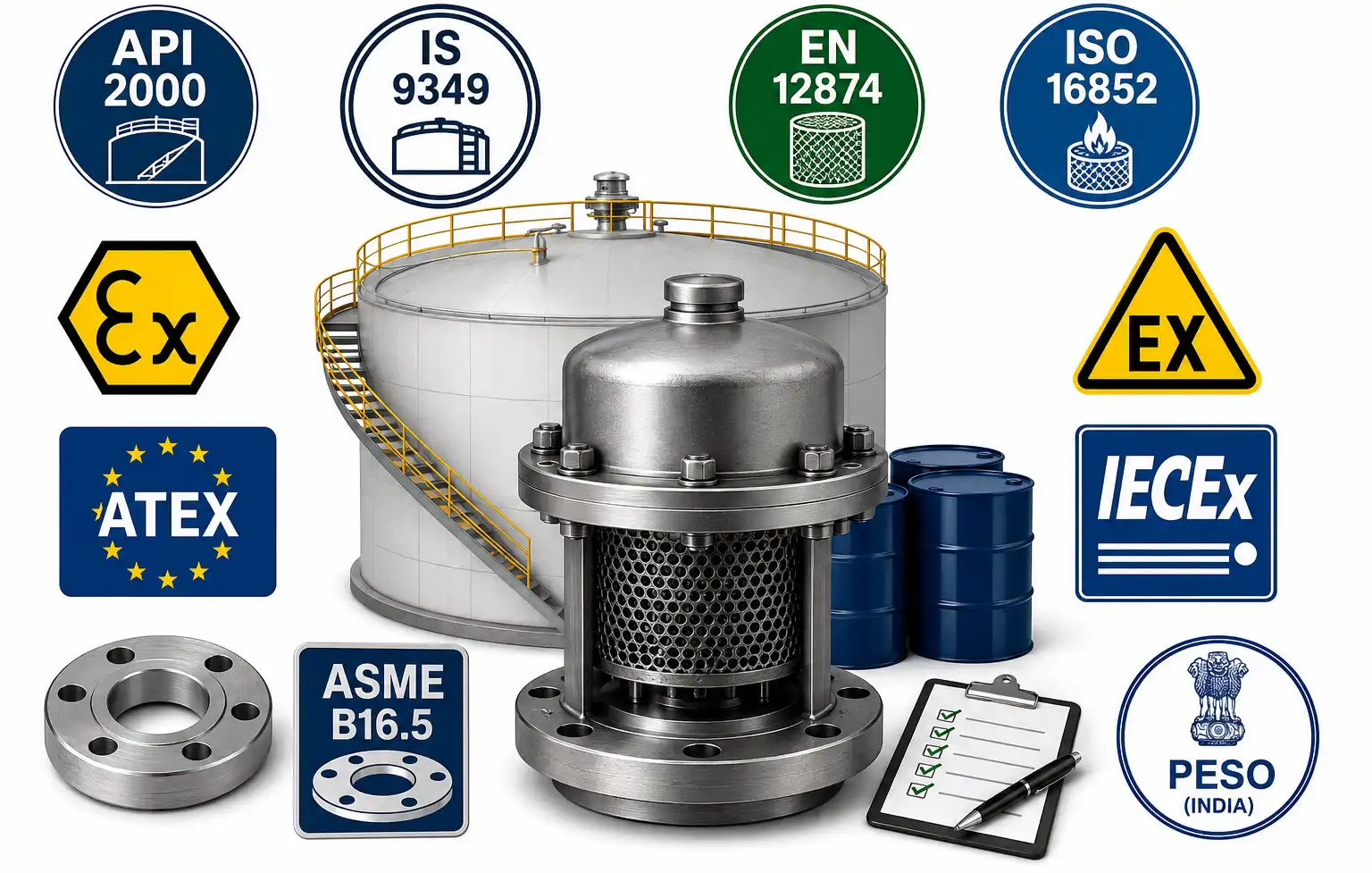
15. Standards and Compliance: API 2000, IS 9349, and ATEX
Standard
Scope
Relevance to Breather Valve
API 2000 (7th Edition)
Venting of Atmospheric and Low-Pressure Storage Tanks
Primary sizing standard for breather valve inbreathing and outbreathing capacity. Referenced globally
for all petroleum and chemical tank venting.
IS 9349
Indian Standard — Pressure Vacuum Relief Valves for Petroleum Storage
Indian equivalent standard for PV valve / breather valve design, testing, and performance. Required
for PESO-regulated installations in India.
EN 12874
Flame Arresters — Performance, Test Methods, Limits
Governs the integrated flame arrestor element in breather valves for flammable vapour service.
ISO 16852
Flame Arresters — Performance Requirements, Test Methods
International equivalent of EN 12874 — referenced in global procurement and ATEX applications.
ATEX Directive (2014/34/EU)
Equipment for Explosive Atmospheres
ATEX certification required for breather valves with flame arrestors installed in Zone 1 or Zone 2
classified hazardous areas.
IECEx
International Electrotechnical Commission Explosive Systems
Global equivalent of ATEX — required for export to international markets.
ASME B16.5
Pipe Flanges and Flanged Fittings
Governs the flange end connection specification — Ventil breather valves are supplied to ANSI B16.5
#150 RF as standard.
PESO (India)
Petroleum and Explosives Safety Organisation
Statutory authority governing petroleum storage installations in India. API 2000 and IS 9349 compliant
breather valves are required for PESO-licensed facilities.
A breather valve (also called a conservation vent, PV valve, tank breather
valve, breather vent valve, or pressure vacuum relief valve) is a dual-function safety device installed on
atmospheric storage tanks. It automatically opens to release excess internal pressure (outbreathing) and to
admit air or inert gas when vacuum forms inside the tank (inbreathing). It protects storage tanks from
structural damage, reduces vapour losses, and maintains nitrogen blanket integrity during normal operations.
They are the same device. A breather valve is also called a
conservation vent, PV valve, tank breather valve,
breather vent valve, or pressure vacuum relief valve. The term
"conservation vent" is more common in the oil and gas industry (API 2000 terminology) and emphasises the
function of conserving product vapour and reducing evaporation losses. The term "breather valve" is more
commonly used in India, the chemical industry, and general manufacturing.
Nitrogen blanketed tanks need breather valves because temperature changes and liquid level
fluctuations constantly change the volume of nitrogen in the tank headspace. During filling, the nitrogen
compresses and pressure rises — the breather valve releases excess N₂. During emptying or cooling at night,
the nitrogen expands or the headspace grows — the vacuum pallet opens to admit fresh N₂ from the supply
line. Without a breather valve, these pressure swings can cause tank over-pressurisation or dangerous vacuum
collapse.
A weight loaded breather valve uses the mass of the pallet weight to set
the opening pressure — simple, no springs, no fatigue. The pallet lifts when gas pressure exceeds the
weight. A spring loaded breather valve uses calibrated springs for more precise and
adjustable pressure setting. Weight loaded types are preferred for very low set pressures and fixed vertical
tanks; spring loaded types suit applications requiring precise control, non-vertical installations, or
pharmaceutical/food-grade service where consistent seating force matters.
Breather valve sizing per API 2000 requires calculating: (1) maximum
outbreathing rate from filling + thermal expansion, (2) maximum inbreathing rate from emptying + thermal
contraction, (3) vapour correction factor based on stored liquid molecular weight vs air, and (4) the
required flow coefficient (Cv or Kv) at the set pressure to pass the required flow. The larger of the
inbreathing or outbreathing capacity governs the valve selection. Use Ventil's free VentilCalc Sizing Tool or contact our
engineering team for complete sizing support.
Ventil breather valves are available in: Carbon Steel (CS) for general
petroleum, chemical, and water service; Stainless Steel CF8 (SS304 equivalent) for food
grade, dairy, pharmaceutical, and mildly corrosive service; and CF8M (SS316 equivalent) for
highly corrosive, chloride-containing, or aggressive chemical service. Custom exotic alloys (Hastelloy,
Duplex SS, Monel) and PTFE-lined bodies are available on request for special applications.
Yes. For tanks storing flammable liquids (flash point below 60°C) or located in classified
hazardous areas (ATEX Zone 1 or Zone 2), the breather valve must incorporate a flame arrestor. The flame
arrestor prevents external ignition sources from propagating back into the tank vapour space, and stops
internal deflagration from propagating outward. Ventil manufactures a unique single-piece casted breather
valve with an integrated flame arrestor — eliminating the need for a separate component and reducing
installation complexity.
Yes. An air breather valve or water tank breather valve
is commonly used on potable water storage tanks, fire water tanks, raw water tanks, and effluent tanks to
protect against pressure and vacuum damage during filling and emptying cycles. For water tank applications,
Carbon Steel or SS304 bodies with EPDM seats are typical. The flame arrestor is not required for
non-flammable water service.
For nitrogen blanketed tanks, the breather valve pressure set point should
be set 10–30 mm WC above the nitrogen blanket operating pressure, and must be below the tank's maximum
allowable working pressure (MAWP). The vacuum set point should be set 5–15 mm WC below the
minimum nitrogen blanket pressure. The exact values depend on your tank design code, nitrogen supply
pressure stability, and stored liquid vapour pressure. Ventil's engineering team can advise on specific set
point recommendations for your application.
Recommended maintenance intervals: monthly visual inspection (external check, vent
blockage, physical damage); quarterly pallet movement check (manually verify free movement); 6-monthly flame
arrestor element inspection (clean or replace if blocked); annual full service (disassemble, replace seats
and seals, verify set pressures). In corrosive, dusty, or sticky-vapour service (resins, bitumen, wax),
increase frequency to every 3–4 months for full service. After any process upset, fire event, or known
overpressure — inspect immediately regardless of scheduled interval.
API 2000 (Venting Atmospheric and Low-Pressure Storage Tanks) is the
internationally recognised standard published by the American Petroleum Institute that defines minimum
venting requirements for atmospheric and low-pressure storage tanks. It is the governing standard for
breather valve sizing (inbreathing and outbreathing capacities), emergency vent sizing (fire case), and
vacuum protection requirements. All Ventil breather valves are sized, rated, and certified per API 2000.
Compliance with API 2000 is required for insurance, statutory inspection, and export of products from
India's petroleum and chemical industries.
Ventil Components Pvt. Ltd. is one of India's leading breather valve manufacturers and
suppliers, with our manufacturing facility at Maan Hinjawadi, Pune, Maharashtra. We design,
engineer, and manufacture breather valves, conservation vents, PV valves, and pressure vacuum relief valves
for the full spectrum of atmospheric storage tank applications across India and internationally.
🇮🇳
Made in India
100% in-house manufacturing, Pune
🏅
ISO Certified
Quality management across all products
✅
CIMFR Approved
Explosion protection certified
🏭
MSME Registered
Make in India — indigenous manufacturer
🔧
Custom Engineering
OEM and custom sizes, materials, pressures
📐
VentilCalc Tool
Free API 2000 online sizing — no registration
🔥
Integrated Flame Arrestor
Unique single-piece casted design
🌍
Export Ready
Supplied to India & international markets
Trusted by India's leading process industries
Our breather valves, conservation vents, and tank breather valves are installed and trusted by Cipla, Biocon,
Dr. Reddy's Laboratories, Procter & Gamble (P&G), Adani, Roquette, Forbes, ISGEC, ISRO (URSC), BARC,
ACC, Ramco, and many more across pharmaceutical, petrochemical, chemical, dairy, food & beverage, and
power industries.
Ready to Select the Right Breather Valve for Your Tank?
Our engineering team provides free API 2000 sizing support, pressure setting guidance, and product selection
for breather valves on nitrogen blanketed and all other atmospheric storage tanks. Available in 1" to 8", CS,
SS304, and SS316, with integrated flame arrestor.
Ventil Components Pvt. Ltd. is India's leading manufacturer of pressure relief and explosion safety
equipment. Our engineering team has deep expertise in API 2000, IS 9349, ASME, and ATEX standards for
atmospheric storage tank protection, nitrogen blanketing systems, and explosion safety across oil & gas,
chemical, pharmaceutical, and food processing industries.