

Introduction
Temperature is one of the most critical variables affecting rupture disc (burst disc) performance. Whether it’s a high-temperature chemical reactor, a cryogenic application, or a storage system exposed to seasonal thermal swings temperature directly influences burst pressure, disc longevity, and overall pressure safety reliability.
Incorrect temperature considerations can lead to
- Premature bursting
- Delayed bursting
- Material deformation
- Metal fatigue
- Safety hazards and non-compliance
This guide explains exactly how temperature impacts rupture disc performance and how engineers, and plant operators should account for it in real-world industrial conditions.
Why Temperature Matters in Rupture Disc Engineering
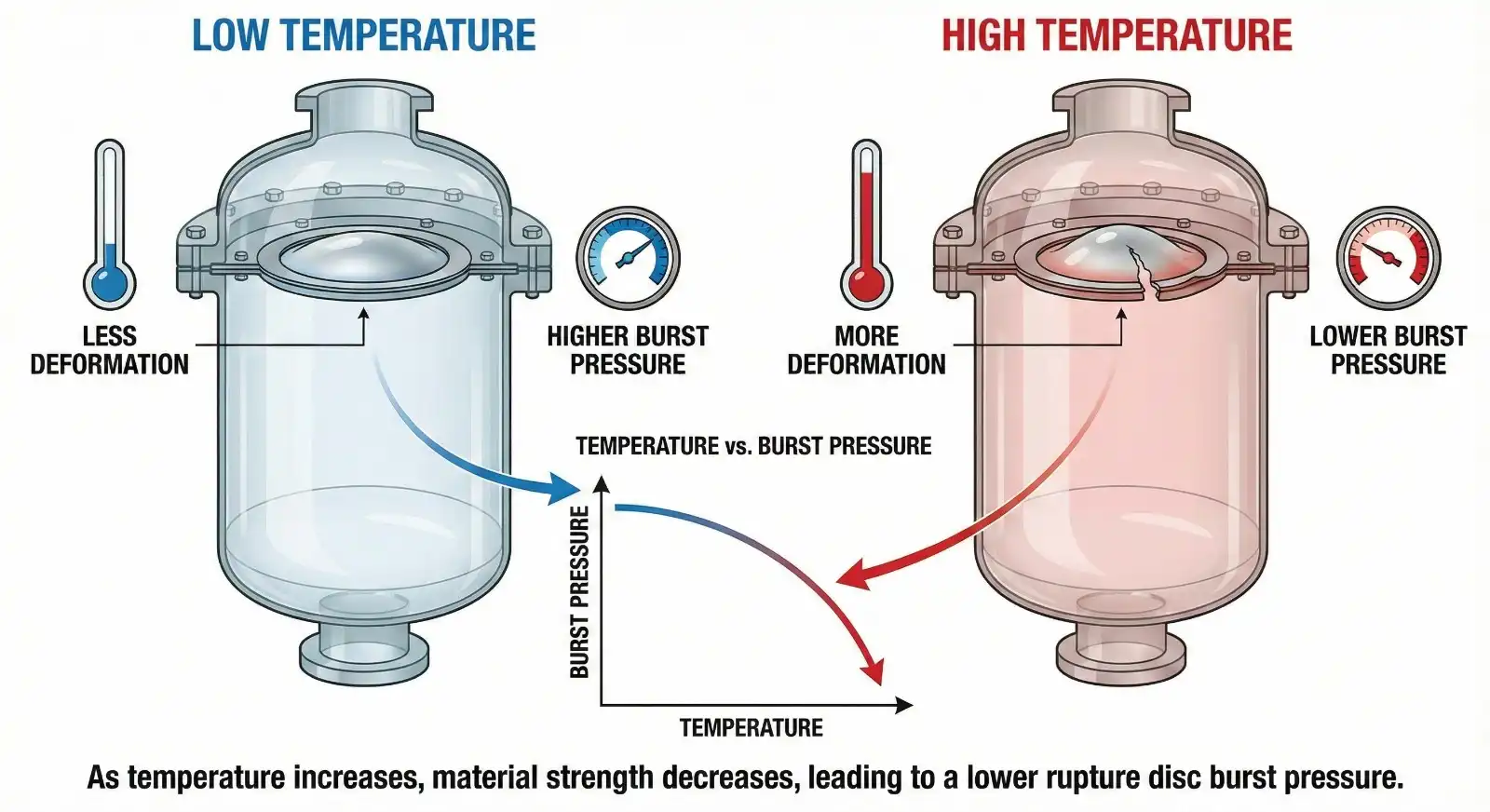
Rupture discs are calibrated to burst at a precise pressure. But pressure and temperature are interconnected:
- Metal expands when heated → reduces strength → lowers burst pressure
- Metal contracts in cold conditions → increases strength → raises burst pressure
- Process media temperature influences thermodynamic behavior → changes internal pressure
Because a rupture disc's burst rating is certified at a specific temperature, any deviation can significantly shift the actual burst point.
1. Burst Pressure Variation with Temperature
Temperature can alter a rupture disc’s tensile strength and modulus of elasticity. The result?
a. When Temperature Increases
- Metal softens → burst pressure drops
- Disc may burst prematurely
- Higher risk in reactors, steam systems, exothermic processes
b. When Temperature Decreases
- Metal becomes stronger → burst pressure increases
- Disc may fail to open at the required pressure
- Risk of vessel overpressure during cold startups
c. Rule of thumb:
A rupture disc’s actual burst pressure may differ by ±20–30% from the certified value when exposed to extreme temperature changes.
2. Temperature Impact on Different Rupture Disc Materials
Different materials respond differently to thermal conditions. Below are key industrial materials:
a. Stainless Steel (SS316 / SS304)
- Withstands moderate temperatures
- Predictable thermal expansion
- Common in chemical, petrochemical, and general industrial processes
b. Nickel & Monel
- Excellent for high-temperature and corrosive environments
- Good stability across broad temperature ranges
c. Inconel & Hastelloy
- Superior high-temperature strength
- Ideal for refineries, high-pressure reactors, and severe services
d. Graphite Rupture Discs
- Outstanding corrosion resistance
- Performance changes significantly with temperature
- Must be carefully sized due to brittle behavior in cold environments
e. Teflon/PTFE Coatings
- Used for corrosion protection
- Limit continuous high-temperature exposure
Correct material selection ensures disc stability despite temperature cycling.
3. Temperature Cycling & Fatigue Failure
a. Industrial systems rarely maintain constant temperature. Daily operations cause:
- Heating and cooling cycles
- Batch process temperature swings
- Seasonal ambient temperature variations
b. These fluctuations cause material fatigue, especially for metallic rupture discs. Outcomes include:
- Micro-cracks
- Premature failure
- Unpredictable burst behavior
Reverse-acting discs generally handle thermal cycling better than forward-acting models due to compressive loading.
4. Superheated vs. Saturated Media A Hidden Risk
The media condition also changes the effective temperature stress on discs.
a. Superheated steam
- Much higher energy
- Can weaken metallic discs faster
- Causes softened dome and delayed burst
b. Cryogenic media (LNG, Liquid Nitrogen, CO₂)
- Extreme cold strengthens the metal → increases burst pressure
- Risk of non-opening during emergencies
Ventil discs are engineered to withstand both extreme heat and cryogenic service with strict certification.
5. Temperature Influence on Vacuum Conditions
Rupture discs are also used for vacuum protection.
a. Low temperature can cause:
- Increased tensile strength
- Disc collapse or reverse buckling failure under vacuum
b. High temperature may lead to:
- Disc becoming too flexible
- Inward deformation during vacuum cycles
Vacuum-rated rupture discs must be temperature-validated to prevent vessel collapse.
6. Effect of Temperature on Burst Disc Holders
a. The holder (clamp or union) also expands/contracts with temperature. If not designed correctly:
- The disc may seat improperly
- Leak paths may appear
- Actual burst pressure changes
- Torque retention may fai
This is why holder–disc compatibility is crucial, especially for high-temperature operations refer to our rupture disc installation guide for installation best practices.
7. Certification Temperatures vs. Operating Temperatures
Rupture discs are certified at a standard temperature commonly 22°C (72°F).
If operating temperature differs, you must apply temperature correction factors provided by the manufacturer.
Example:
A disc certified at 10 bar @ 22°C may burst at:
- ~8.5 bar @ 200°C
- ~11.5 bar @ -50°C
Never size a rupture disc without considering its operating temperature range.
8. How to Choose the Right Rupture Disc for Temperature-Sensitive Applications
a. Identify the maximum continuous operating temperature (MOC)
Consider worst-case scenarios.
b. Select disc type based on thermal stability
- Reverse-acting discs → excellent for high & cycling temperatures
- Forward-acting discs → better for clean media, low temp variations
- Graphite discs → best for corrosive, stable-temperature processes
c. Choose the right material & thickness
Metallurgy must match the thermal profile.
d. Account for temperature correction factor
Always apply manufacturer-provided charts.
e. Validate installation torque under hot/cold conditions
Torque loss is common in high-temperature systems.
f. Use temperature monitoring & insulation
Keeps the rupture disc within its designed range.
9. Importance of Temperature in Maintenance & Inspection
a. Temperature-induced wear accelerates:
- Creep
- Stress corrosion cracking
- Metal thinning
- Bulging or dome deformation
b. Maintenance should include
- Visual thermal damage inspections
- Measurement of dome profile
- Checking holder alignment
- Verifying torque after thermal cycles
Temperature also influences other pressure safety devices like flame arrestors and emergency vents, so a broader safety assessment is essential.
10. Best Practices for Accurate Temperature Consideration in Rupture Disc Design
- ✔ Always use actual operating temperature, not ambient temperature
- ✔ Consider startup, shutdown, emergency, and seasonal temperatures
- ✔ For high-temperature environments, use Inconel or Hastelloy
- ✔ For cryogenic applications, ensure discs are temperature-tested
- ✔ For high cycling, choose reverse-acting discs
- ✔ For precise adjusted sizing, use the VentilCalc rupture disc sizing tool.
Conclusion
Temperature is not a minor variable it is a core engineering parameter that defines rupture disc accuracy, reliability, and compliance.
When selecting, sizing, or installing rupture discs, temperature must be considered with the same importance as pressure. By understanding how thermal conditions affect burst pressure, material behavior, and disc longevity, industries can ensure safe and predictable pressure relief performance.
Ventil rupture discs are designed, engineered, and tested to withstand wide temperature ranges, ensuring safety across chemical processing, oil & gas, pharma, food manufacturing, and high-temperature industrial applications.
Need assistance selecting the right rupture disc for a temperature-sensitive application? Contact Ventil’s engineering team for expert guidance.
Frequently Most Asked Questions
Temperature affects the tensile strength of rupture disc material. High temperatures reduce the strength and lower burst pressure, while low temperatures increase the strength and raise the actual burst point.
Rupture discs are certified at a standard temperature. If the actual operating temperature differs, correction factors ensure the disc opens at the correct pressure
Alloys like Inconel, Hastelloy, and Monel provide excellent strength and temperature stability, making them ideal for high-temperature services.
Yes. Frequent heating and cooling cycles cause metal fatigue, micro-cracks, and unpredictable burst behavior especially in forward-acting discs.
At cryogenic temperatures, metal becomes stronger, which may delay rupture. Cryogenic-rated discs are tested and calibrated to ensure reliable opening.
Yes. Holders expand or contract with temperature, which may alter torque retention, sealing, and disc alignment.
Yes. Insulation can trap heat and raise disc temperature beyond expected limits, altering burst precision.


